Short answer
Clear Central Coast gutters in late autumn, roughly the second half of October through mid November. Rain here does not arrive until then, so the common advice to clean in spring and fall is off by weeks. Wait until the leaf and needle drop has finished, then get everything out before the first real storm. Homes under Monterey pines or mature oaks want a second clear out in January or February. Inland properties should also pull dry needle litter off the roof and out of the gutters before fire season, which is a separate job from the rain one.
The usual gutter advice is written for a different climate
Most gutter advice tells you to clean twice a year, spring and fall. That advice comes from parts of the country where summer brings thunderstorms and winter brings a freeze, so a blocked gutter turns into an ice dam and lifts the shingles off the eave. Neither of those things happens in San Luis Obispo County. We get essentially no rain from May through October. For half the year your gutters are not being tested at all. They are just being loaded.
So the clock here is not set by the season. It is set by the rain. The first real storm usually lands somewhere between late October and early December, and everything that has fallen since spring is still sitting up there when it arrives, dry and packed down. The job wants doing after the leaf and needle drop has finished and before that first storm. Get the order wrong and you either clean a gutter that is about to fill again, or you clean it after the water has already found the fascia.
For most homes in the county that puts the window somewhere in the second half of October through the middle of November. It is a short window, and everybody wants it at once. If you are reading this in August, August is a good month to get on a schedule and a poor month to actually do the work, because most of what is going to fall has not fallen yet.
After the drop, before the first rain
Two conditions have to be true. The drop has to be finished, and the rain has not started. On a valley oak property the first condition runs late, because oaks in Atascadero and Templeton still let leaf go into November in a warm year. Clear it in the third week of September and you have paid for a gutter that fills back up in six weeks. Pine is different again, because Monterey pine sheds all year and there is no finish line to wait for.
The other end of the window matters more. A gutter that overflows once in a freak October shower is not a problem. A gutter that overflows in every storm from November to March is how fascia boards rot and hangers pull loose. Once the rain starts, ladder work gets slower and more careful, the schedule fills with people who just watched a sheet of water come off their roofline, and the wet debris weighs several times what it did in October. Here is roughly how the year runs.
- August and September: book it. Most properties do not need clearing yet, but the schedule is still open.
- Late October to mid November: the main clear out, once the leaf drop is done and before the first real storm.
- December: still worth doing if you missed the window. A gutter cleared then has three months of rain left to handle.
- January or February: a second clear out if pines or mature oaks hang over the roof, because wind and early rain bring down another load.
- May and June, inland only: a fire season clear out, about dry litter on the roof edge rather than drainage.
What is in your gutter depends on which town you live in
In Cambria and Cayucos it is Monterey pine, and pine needle is the worst thing that can land in a gutter. Needles do not come down in one seasonal drop, they shed all year, so there is no quiet period. Once they are in the trough they lie flat and interlock. After a couple of seasons that is not loose debris any more. It is a mat of felt that water sits on top of instead of passing through, and it lifts out in slabs rather than handfuls.
Around Atascadero, Templeton, Creston and Paso Robles it is oak. Valley oaks are deciduous, so you get a real drop over a few weeks in autumn, which at least gives you a date to work back from. The leaves are small and curl up, so they pile instead of matting. The acorns are the actual problem. An acorn is exactly the wrong size for a gutter: it rolls along the trough, wedges in the first downspout elbow it reaches, and everything else packs in behind it.
Down in Pismo Beach, Grover Beach, Oceano and around Los Osos it is eucalyptus, which sheds in a way nothing else does. Long ribbons of bark peel off the trunk year round, and a ribbon of bark does not wash through anything. It drapes over the downspout outlet like a rag on a drain. Then there are the hard seed caps, which behave like acorns and jam the same elbows. Eucalyptus litter travels on the wind too, so you can find it in a gutter on a lot with no eucalyptus on it.
What a blocked gutter actually does
The first thing is the obvious one. Water that cannot get down the downspout goes over the front lip in a sheet, and that sheet lands at the base of the wall and against the foundation. That is the expensive failure and the slowest one to show itself. Our clay soils swell when they get wet and shrink when they dry, and the whole point of a downspout is to move roof water away from the house before that starts happening under one corner of it.
The second one nobody sees, because it happens behind the gutter. A full trough lets water back up over the rear edge and run down between the gutter and the fascia board. The back of a fascia is usually raw wood. Keep it wet through a winter and it goes soft, the spikes or screws holding the gutter lose their grip, and the run drops at one end. By the time a gutter is visibly sagging, the fascia behind it has been wet for years.
The third one you will notice from the driveway. Leaf litter sitting in water makes tannin, a tea colored liquid that seeps out of the gutter seams and runs straight down the wall underneath. On light stucco that shows up as a dark streak under the eave that does not weather off. Black algae usually follows, because the wall stays damp. Once it is on the wall it has stopped being a gutter job and become a washing job.
Inland, the dry season risk is fire before it is water
There is a second reason to care about gutter timing inland, and it has nothing to do with drainage. A gutter packed with dry pine needle and oak leaf is a strip of kindling running along the edge of your roof, sitting at exactly the height where wind driven embers land. Most homes lost in a wildfire are not lost to a wall of flame arriving at the property line. They go to embers that traveled ahead of it and found something dry to settle in.
California's defensible space rules ask you to keep roofs and gutters clear of dead leaves and needles, and the first few feet around the structure get the most attention. For properties around Paso Robles, Creston, Templeton and the east side of Atascadero, that means two timings rather than one. A light clear out heading into summer for the fire risk, and the main one in late autumn for the rain.
The summer clear is a lighter job than the autumn one. It is mostly loose dry litter, and the roof valleys and the flat spots behind a chimney matter as much as the trough itself, because that is where needle collects and stays put. If you have pines on the property, do not wait for a red flag warning to think about it. The litter is already bone dry by June.
How to tell yours need doing without getting on a ladder
You can read most of it from the ground. During rain, stand back far enough to see the whole roofline and watch where water comes over the front edge. Overflow at one spot means a plug somewhere downstream of it, usually the nearest elbow. Water running out of a seam means the same. In dry weather, look for anything growing up there. A seedling in a gutter means there is soil in it, and soil means two or three years of debris quietly breaking down.
Then look down. A trench worn into the bark mulch or a channel cut in the dirt along the drip line is proof of overflow even if you never watched it happen. Dark vertical runs on the wall under a gutter seam are the same evidence. Sight along each run from the corner of the property, because a gutter should be dead straight, and any dip in the middle is either a failed hanger or the weight of water sitting on packed debris.
One thing worth saying plainly, because people ask every year. Crystal Clean A1 does not install gutter guards or leaf guards. We do not fit them and we do not quote for them. If you already have them, they cut down how much gets in, but they do not end the maintenance, and pine needle in particular sits on top of most guards and works through the mesh anyway. Drop in guards can usually be lifted so we can clear underneath. Screens screwed down or tucked under the shingle course sometimes cannot come off without damage.
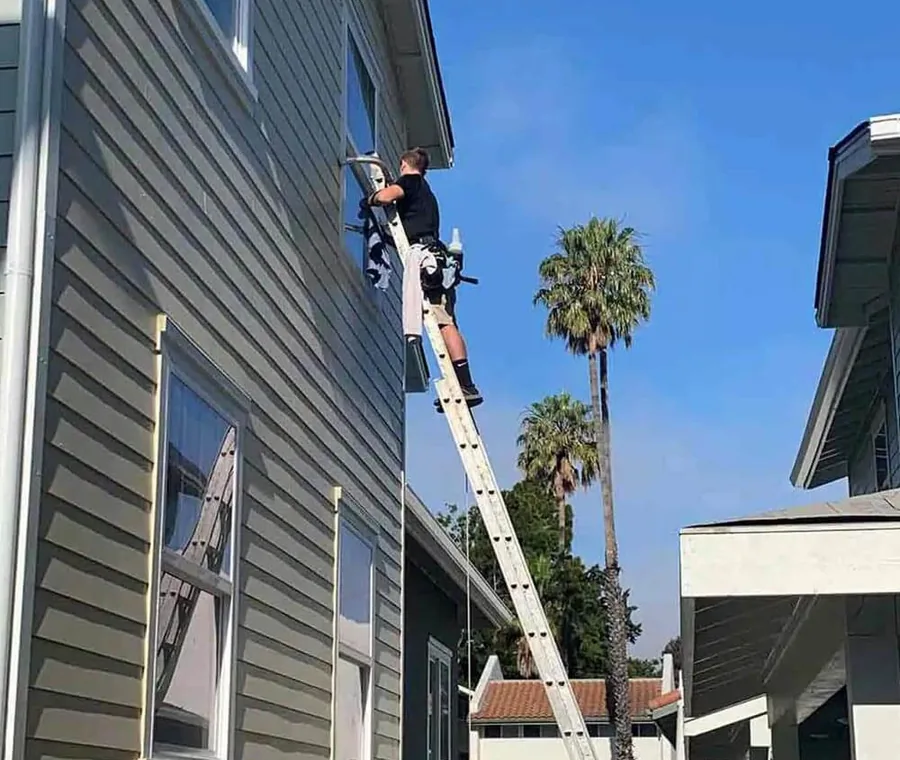
Corey Byler does this work himself, on the ladder, and nothing is handed to a subcontractor at any point. Booking in late summer usually gets you the slot you want rather than the one that is left. The phone is (805) 952-5718, Monday to Saturday, 7:00 AM to 6:00 PM, and every job ends with a walk around with you before anything gets packed up.
Questions people ask about this
What month should I clean my gutters in San Luis Obispo County?
Is it too late to clean gutters once the rain has started?
Do gutters here need cleaning twice a year?
Do you install gutter guards?
Do pine needles really block a gutter, or do they wash through?
Related on this site