Short answer
Work top down and finish before the first storms, which on the Central Coast usually arrive in November. Clear the gutters and flush every downspout first, so the water has somewhere to go. Treat roof growth next. Wash the walls after that. Do driveways, patios and walkways last, because runoff from the higher work will restain flatwork you already cleaned. October is the window. Waiting until January means the growth holds moisture against your roof and walls all winter, and you live with it until spring.
The first storm is the deadline, not the start of the season
Rain here keeps its own schedule. Most years nothing meaningful falls between May and October, and the first real storm shows up somewhere in November. Some years it holds off until December. That gap is longer than people moving from anywhere else expect, and it changes how the outside of a house behaves. Everything that lands on your roof between spring and autumn stays exactly where it fell. Leaf, needle, oak tassel, harvest dust and pollen never wash through in stages the way they do in a climate with summer rain. They stack up and they compact.
So the first rain of the season is the dirtiest rain of the year, and it moves six months of material at once. The roof sheds all of it into a gutter that is already full. Downspout elbows plug inside the first hour. The trough fills, and water goes over the front lip in a sheet instead of down the pipe. That sheet lands against your stucco and at the base of the foundation. The runoff itself is dark, because it is carrying dissolved organic material off the roof, and it stains the walls and the flatwork it crosses on the way down.
The second half is slower and worse. Once the wet season starts, the damp does not leave. Surfaces stop drying out between storms, especially north and west elevations and anything sitting in shade. That packed bed of organic material on the roof is now a wet sponge held against your tile or your shingle for four or five months straight. Clearing it in October costs a morning. Getting to it in March means a whole winter of damage has already happened.
Work top down: gutters, roof, walls, then flatwork
Gravity does the scheduling for you. Water runs downhill and so does everything it is carrying, which means any surface you clean underneath a dirty one gets dirty again the moment somebody turns a hose on above it. People find this out by washing the driveway first, on the nice Saturday, and then watching a roof wash two weeks later run brown straight across it. The order is not a preference or an upsell. It is the difference between doing the job once and paying to do the bottom half twice.
Gutters lead for a practical reason on top of the sequence. Roof cleaning puts a lot of water on a roof, and all of it ends up in the trough. If a downspout elbow is packed, that water backs up and spills over the lip onto walls nobody has washed yet. Proving each downspout runs clear first gives the rest of the work somewhere to drain. When the roof is treated the same day, check the trough again afterward, because dead growth keeps letting go for weeks. After that the sequence is the same on a beach cottage in Cayucos and a ranch house outside Templeton.
- Gutters and downspouts. Debris out by hand, every downspout flushed from the top and watched at the bottom outlet until it runs clear.
- Roof. Algae streaking, moss and lichen treated at low pressure, and the valleys and tile pans cleared of litter.
- Walls. Stucco, siding, eaves, soffits and the outside face of the gutters, which is where roof runoff dries into that dark band.
- Windows. After the walls, because a rinse is not a clean and glass spots as it dries.
- Flatwork. Driveway, walkways, patio and steps last, since everything above them has already drained across them.
What the damp actually does once it arrives
Roof algae, moss and lichen are alive, and they spend the dry half of the year barely ticking over. The spores are already up there, and so is the bed of leaf litter and dust they feed in. The only thing missing is water. The first rains supply it and the wet season keeps supplying it, so growth that read as light streaking in September can be a visible mat by February. In the fog belt, Cambria, Cayucos, Morro Bay, Baywood-Los Osos and Avila, the marine layer tops it up overnight even in weeks with no storm.
The part that costs money is not the color. It is that growth holds water against the surface underneath it. Moss sitting in the gaps between composition shingles wicks water sideways under the course instead of letting it run off the top. Lichen grips clay tile and keeps the pan below it damp. A green black film down in stucco texture stops a wall drying out, and a wall that never dries keeps the trim and the fascia board behind it wet as well. Soft fascia is how gutter hangers pull loose and a whole run starts to sag.
Concrete does the same thing at ground level with an extra problem attached. Algae on a north facing walkway or a shaded patio goes slick the moment it is wet, and around here it stays wet from November through March. Cleaning flatwork before the rain is half cosmetic and half about not leaving a skating rink outside your back door for the winter.
Why January is the expensive month to call
Two things happen if you leave it. The first is that you live with it. Roof and wall cleaning wants a dry surface, a dry forecast and enough hours after to let everything settle, and mid winter on the Central Coast hands you those in short, unreliable windows. A storm every week means the job keeps getting pushed a fortnight. By the time there is a dependable dry stretch it is often March or April, so the roof you first noticed in November stays exactly as it is until spring.
The second is that the growth is not waiting with you. Winter is its growing season here. Whatever is on the roof in November is thicker and better rooted by February, and lichen in particular is far harder to shift once it has had a damp season to grip with. The same job takes longer later, and the walls under a dirty roof pick up fresh streaking from every storm in the meantime. Calling in September or early October usually gets you a better slot than calling the week rain first appears in the forecast.
If it is already January, do not write the winter off. Gutters are the exception and they are worth clearing wet, because a plugged downspout in the middle of the rainy season is the one problem actively doing damage right now. Roof and wall work can hold for a dry stretch, and so can flatwork. The order stays the same whenever you get to it. You are just working with less daylight and a shorter forecast.
Which parts you can reasonably do yourself
A good share of this is homeowner work and pretending otherwise would be dishonest. On a single story house with a simple roofline, clearing gutters is a ladder, gloves, a bucket and a couple of hours. Scoop it out by hand rather than blowing it out. Wet matted needle will not blow, and a blower packs the plug in the elbow tighter instead of removing it. Then run a hose down each downspout from the top and go and look at the bottom outlet. If it is not running clear, it is not clear.
Flatwork is the other job most people can handle. A rented pressure washer with a surface cleaner attachment does a respectable job on plain concrete, as long as you keep it moving and stay off soft mortar, old brick and anything sealed. Hosing out your window tracks and sills before the rain is worth ten minutes too. Grit sitting in a track is exactly what runs back down a clean pane the first time it gets wet, and it is why a lot of people think their windows were never cleaned properly. The line to draw is height and roofs, and it is not a soft line.
- Do not walk a clay or concrete tile roof. Tile cracks in the middle of the span, and nobody finds the crack until it leaks months later.
- Do not put a pressure washer on a roof of any kind. It strips the ceramic granules off composition shingle and drives water up under tile laps.
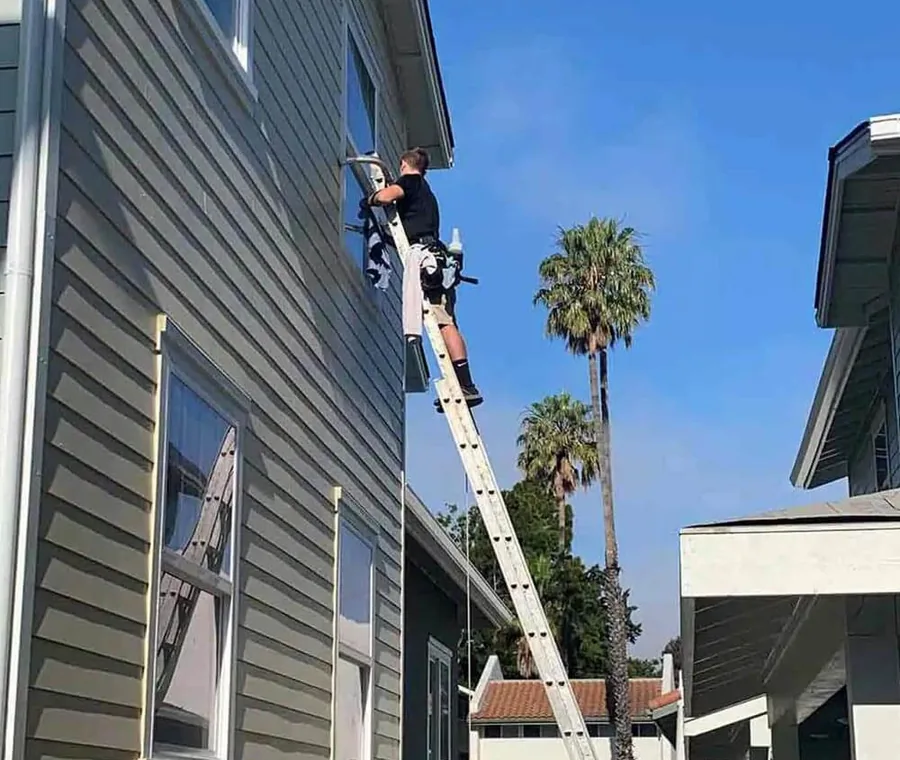
- Do not do two or three story ladder work, and do not do any ladder work alone. Most gutter injuries are a ladder on soft autumn ground with nobody footing it.
- Do not reach sideways for a downspout outlet at height. Overreaching off a ladder is how the fall happens, not climbing it.
- Do not spray a cleaning mix near planting without soaking the beds with plain water first and rinsing them again after.
A timeline that works on the Central Coast
August and September are for booking, not for the work. Late September through October is when the work should actually happen, in that order, ideally in one visit or two close together so nothing higher up gets cleaned after something lower down. November is when you want it all finished and the first storm arrives to a roof that sheds and a downspout that runs. January or February is a good moment to clear the gutters a second time if you have Monterey pines or mature coast live oaks over the roof, because winter wind brings another load down.
Everything past that homeowner line is what Corey Byler does for a living. He followed his father into the trade, he is the one on the ladder, and nothing is handed to a subcontractor at any point. Business License #17881, insured to $1,000,000, certificate on request. Monday to Saturday, 7:00 AM to 6:00 PM, on (805) 952-5718. Every job ends with a walk around with you before anything gets packed up, and anything you are not happy with gets put right there and then.
Questions people ask about this
What order should you clean the outside of a house in?
When should I clean my roof and gutters before the rainy season in San Luis Obispo County?
Why does algae and mold get worse in winter here when it barely rains in summer?
Is it too late to clean my house exterior once the rain has started?
Should windows be cleaned before or after the house is washed?
Related on this site