Hard surfaces only
Pressure Washing Services in San Luis Obispo County
High pressure belongs on concrete, pavers, brick and block. It does not belong on stucco, wood or a tile roof, and knowing the difference is most of the job.
Mon to Sat, 7am to 6pm · License #17881 · Insured to $1,000,000
Get a fast quote, it takes about five seconds
High pressure is the right answer on about half your property
The skill is knowing which half, and putting the machine away for the rest.
Concrete looks solid and is not. It is porous, and around here it spends a good part of the year damp. In Cambria, Cayucos, Morro Bay and Los Osos the fog sits in until late morning, so the shaded side of a patio never fully dries between May and October. What grows there is a green black film that keys down into the surface rather than sitting on it. Closer to the sand in Avila, Shell Beach and Pismo, salt settles on top of that. A broom moves the loose part. The part holding the color needs water at pressure.
Inland the dirt is different and just as stubborn. Every autumn the crush pulls harvest dust off the vineyard rows and tractor traffic across Paso Robles, Templeton, Creston and the Edna Valley, and it lands on patios and walkways that will not see rain again for months. Well water sprinklers crust the edge of a walkway with calcium. Along the Highway 101 corridor, storefront sidewalks in San Luis Obispo and Grover Beach pick up road film and tire black, and apartment breezeways and stairwells around Cal Poly take a beating that only shows up once the students clear out in June.
The other half of the job is knowing when to shut the pressure down. Stucco is on most of the houses in this county, and a fan tip will strip the sand off it and drive water in behind. Clay tile cracks under a jet the same way it cracks under a boot. Painted trim, redwood fencing and composite decking all lose more than they gain. Those surfaces want low pressure and the right cleaner, which is soft washing and is its own page. Hard flat surfaces are where pressure earns its keep, and there it beats everything else.
How the job actually runs
Corey Byler is on the job, not just on the invoice. Nothing is subcontracted at any point, so the person who looked at your patio is the person running the machine across it.
We work out what the surface will take
It starts with a test spot somewhere out of the way. Broom finish concrete, pavers, flagstone, stamped concrete and old brick all have different limits. We check for loose mortar, spalling and flaking sealer first, because pressure finds every weak spot the slab already had.
Blow it off, then decide where the water goes
Loose grit gets blown off before any water touches it, otherwise it turns to slurry and rides straight into your planting beds. Doors, outlets, light fittings and vents get covered. Runoff gets planned on the way in, kept off landscaping and out of storm inlets where that matters.
Treat it first, then let it sit
Algae, mildew and the black film on shaded coastal concrete come off with a cleaner and a few minutes of dwell time, not with brute force. Doing that first means we can rinse at a pressure that leaves the surface intact instead of chewing into it.
Surface cleaner across the open ground, wand only at the edges
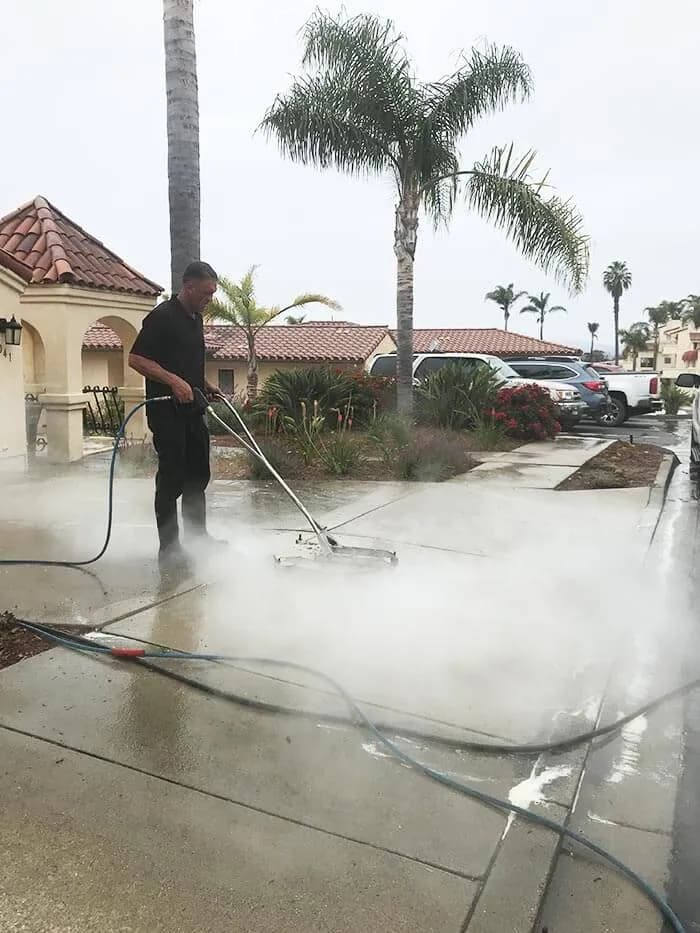
Flatwork gets a surface cleaner: a shrouded head with spinning jets that holds one height and one speed across the whole path. That is what stops striping. Edges, steps, corners and expansion joints are finished by hand with a wide fan tip, kept moving and kept back.
Rinse down, sweep up, walk it with you
The whole area gets rinsed so nothing dries as a tide line, and the debris gets swept up instead of pushed into a corner. Then we walk it with you before packing up, and anything you are not happy with gets put right there and then.
What is included
- Patios, walkways, steps, courtyards, pool decks, breezeways and stairwells
- Block walls, brick, pavers, flagstone and stamped concrete, each washed at the pressure that surface will actually take
- A test spot in an out of the way corner before we commit to the whole area
- Surface cleaner passes on all flatwork, so you get an even finish and no wand stripes
- Edges, steps, corners and expansion joints detailed by hand where a surface cleaner cannot sit flat
- Debris blown off first and swept up after, so grit does not end up in your beds
- Commercial flatwork: entry sidewalks, dumpster pads, drive throughs and trash enclosures. No job is too big or too small
- A walk around with you before we pack up
What we do not do
Worth saying plainly, so nobody is waiting on something we were never going to do.
- Roofs. Tile and composition roofs never see high pressure from us. That is a soft wash and it is a separate job.
- Stucco, painted trim, wood siding and composite decking. Pressure drives water behind them and takes the finish with it. Those get soft washed instead.
- Concrete repair. We will show you spalling, hollow sounding patches and failing mortar, but patching them is somebody else's trade.
Real reviews, real Central Coast addresses
The light literally shines brighter
Every word below is lifted straight from Corey's Google profile. Nothing written by us, nothing tidied up.
What pressure washing costs around here
Central Coast market rates for hard surface washing generally run around $0.20 to $0.40 per square foot on residential flatwork, with most patio and walkway jobs landing somewhere between $150 and $450. Larger commercial flatwork is often priced lower per foot or by the hour. Those are regional ranges to set expectations, not our quote. Send an address and a rough idea of how much surface there is and you get a real number.
Square footage, and the shape of it
One open patio is quick. The same footage cut up into narrow paths, planters and steps means the surface cleaner comes off and the wand goes on, and that takes several times longer.
What is actually sitting on the surface
One season of dust rinses off. Years of shaded algae in Cambria or Los Osos needs a cleaner and dwell time before anything gets rinsed, and dwell time is time on the job.
Surface type
Plain broom finish concrete takes full pressure. Pavers, flagstone, stamped and colored concrete need lower pressure, more chemistry and more passes, so they cost more per foot, not less.
Water supply and runoff
A working spigot near the work is the cheap version. No water on site, or a commercial lot where runoff has to be contained and recovered, both push the number up.
Access
Hillside lots around San Luis Obispo, side gates too narrow for a surface cleaner, second story balconies and apartment stairwells all add time and sometimes ladder work.
One off or on a schedule
Commercial entrances and restaurant patios booked monthly or quarterly cost less per visit, because the surface never gets bad enough to need the slow work.
No obligation, no pressure, no call center
We Guarantee 100% Satisfaction
Every job finishes the same way: a walk around with you before we pack up, so anything you are not happy with gets put right there and then. Corey Byler is the one doing that walk around. Business License #17881, insured to $1,000,000, and no part of the job handed to somebody else.
Pressure Washing questions we get asked
What is the difference between pressure washing and soft washing?
Can pressure washing damage concrete?
Does PSI or GPM matter more for pressure washing?
Why does my patio have stripes on it after it was washed?
Can you pressure wash pavers, stamped concrete and flagstone?
How often should patios and walkways be pressure washed on the Central Coast?
Service area
One truck, the whole county
From the fog line in Cambria down to Santa Maria and inland through Paso and Creston. If you are on this list we get out to you. If you are just off it, call anyway and we will tell you straight.
Often booked with this
Ready to see what your glass actually looks like?
Send an address and we will get you a real number. Residential or commercial, anywhere from Cambria to Santa Maria.
Monday to Saturday, 7:00 AM to 6:00 PM · Owner operated · Nothing subcontracted