Short answer
Streaks come from too much soap, not too little cleaning. Most people use ten times the detergent they need, and the leftover film dries into lines. Use two or three drops of dish soap in a gallon of cool water, nothing more. Work in shade so the solution cannot dry on the glass before you pull it off. Skip paper towel and newspaper, because both shed fibers. Wipe in straight overlapping passes rather than circles, then pull a squeegee with a fresh rubber edge down the pane, wiping the blade dry after every stroke. That handles ground floor glass fine.
Streaks are a residue problem, not a dirt problem
A streak is not dirt you missed. It is something you left behind. Glass has no texture for anything to hide in, so once the grime is off, the pane is either clear or it has a film on it. That film is nearly always your own cleaning solution, dried in place. This is why the second wipe often looks worse than the first, and why people end up going over the same window four times and getting angrier with each pass.
Too much detergent is the single most common cause. Dish soap is built to cling and foam so it can lift grease off a plate, and then you rinse the plate under a tap. A window never gets rinsed. Whatever soap goes on stays on, and as the water evaporates it leaves a thin film that dries into lines. Most people use something like a squirt into a bucket. The right amount is two or three drops in a full gallon. If you can see suds, you have already overdone it.
Sun is the second cause and the easiest to fix. Glass in direct afternoon light gets hot to the touch, and your solution starts drying the moment it lands. You are racing evaporation, and evaporation wins. Work the shaded side of the house first and follow the shade around as the day moves. On the Central Coast that usually means west facing glass in the morning and east facing glass after lunch. If the whole wall is baking, come back another day.
- Too much detergent, which leaves a film that dries into lines
- Direct sun, which dries the solution before you can pull it off
- Circular wiping, which moves the film around instead of removing it
- Paper towel and newspaper, both of which shed fibers onto the glass
- A squeegee blade that is dull, nicked, or never wiped between passes
A homemade window cleaning solution that works
You do not need a branded product. A gallon of cool water and two or three drops of liquid dish soap cleans residential glass as well as anything sold in a spray bottle, because the soap is only there to break surface tension and let your cloth or applicator slide. If your tap water is hard, use distilled water instead. It costs about a dollar a gallon and removes the biggest variable in the whole job, which is the mineral your own water leaves behind as it dries.
White vinegar earns its place on greasy glass, kitchen windows above a stove, or anything carrying an old film of polish or bug spray. A cup of vinegar per gallon is plenty, and you can leave the soap out when you use it. Two cautions. Keep vinegar off natural stone sills, because it etches marble and limestone. And do not put ammonia glass cleaner on any window with interior tint film, since it attacks the adhesive and the film starts to purple at the edges.
Be realistic about what this mix is for. A homemade solution and a decent squeegee will handle the ground floor glass on most homes, a slider, a picture window, the panes you actually look through every day. That is a genuinely worthwhile Saturday. It is not a substitute for a full clean of a two story house, it will not touch mineral deposits, and it does nothing for screens and tracks, which is where half the dirt on a window lives.
- One gallon of cool water, distilled if your tap water is hard
- Two or three drops of liquid dish soap, and no more than that
- Optional for greasy glass: one cup of white vinegar instead of the soap
- Mix in a bucket, not a spray bottle, if you are doing more than two panes
Paper towel, newspaper and the circle problem
Paper towel is made of short wood fibers held together loosely so the sheet can absorb. Drag it across wet glass and it sheds those fibers onto the pane, then smears the ones it has not dropped yet. You get lint in the corners and a haze across the middle. It also loads up with the soap film you are trying to remove and starts putting it back on the glass. If paper towel is all you have, use it on the frames and keep it off the pane.
Newspaper is the advice everybody's grandmother gave, and it made more sense when newsprint had rag content and oil based ink. Modern newsprint is recycled fiber printed with soy ink. It goes soft the moment it is wet, shreds into pills, and transfers ink onto white vinyl frames and your hands. It is also small, so you make dozens of tiny passes on a pane that wanted three. Nothing about it beats a waffle weave microfiber towel that costs a few dollars and lasts for years.
Then there is the motion. Circles feel productive because you can watch the cloth working, but a circle has no exit. You are pushing the same film around the pane and setting it down again on the next lap, which is why circular wiping leaves that faint swirl you only notice when the light catches it. Wipe in straight overlapping passes instead, all running the same direction, each one finishing off the edge of the glass so the residue has somewhere to go.
- A waffle weave microfiber towel for wiping and drying
- A strip washer or a clean sponge to wet and scrub the pane first
- A squeegee with fresh rubber, sized to fit inside the frame
- A dry lint free cloth kept only for the edges and the frame
- No razor blades. Some tempered glass carries fabricating debris from the factory, and a blade will drag it and scratch the pane permanently.
How to pull a squeegee without leaving lines
The rubber edge does all the work, and it has to be sharp. New rubber has a crisp square edge that wipes the pane completely dry behind it. Once it rounds off, picks up a nick, or takes a set from being stored resting on the blade, it leaves a fine line down every single pane and no amount of technique fixes that. Replacement rubber costs a few dollars. Flip it or change it as soon as the glass stops coming out dry, and keep the squeegee out of the sun.
The pull itself is simple once somebody shows you. Wet and scrub the whole pane first so the dirt is genuinely loose. Then start at the top, tilt the squeegee so the leading corner touches first, and pull straight down in one steady stroke without stopping halfway. Wipe the blade dry on a towel. The next pass overlaps the last one by about an inch, into the area you already dried, not up against the edge of it. A gap of even a hair leaves a line.
Finish across the bottom edge with a single horizontal pull, or wipe it with a dry towel. Detail the perimeter, the last quarter inch where the glass meets the frame, using a dry lint free cloth wrapped over one finger. Do not let that cloth wander into the middle of the pane, because by then it is carrying everything it picked up at the edges. Then stand well back and look at the glass on an angle. Streaks hide from you when you stand square to them.
Where doing it yourself stops working
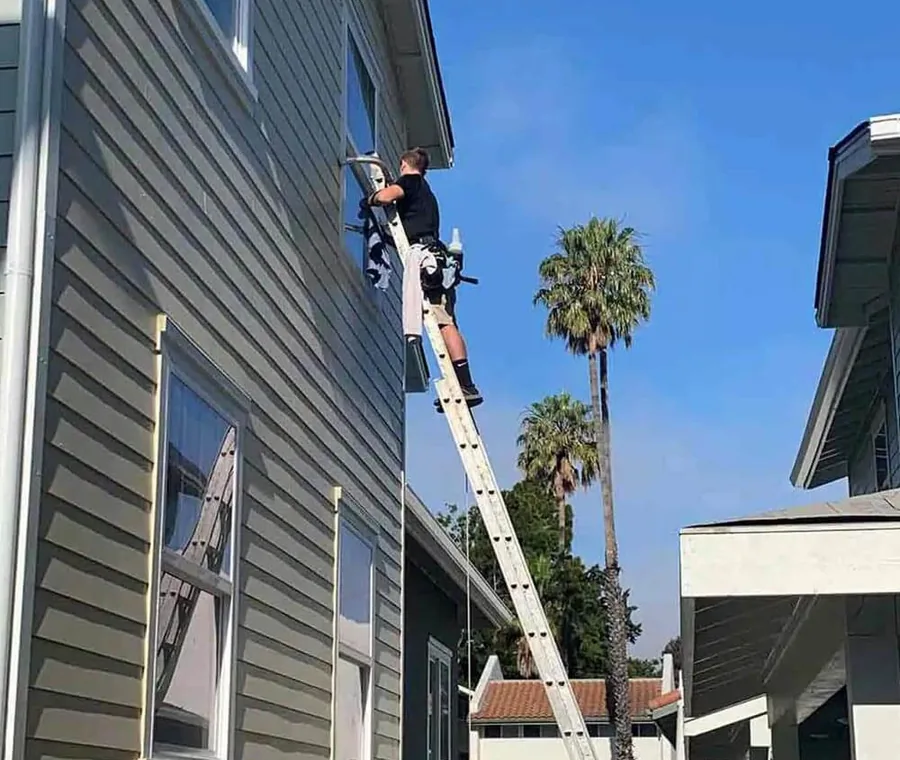
Height is the honest stopping point. A clean pull needs both hands and your weight over your feet, and a ladder gives you neither. You end up reaching sideways, which is how people fall, and half stretching, which is how you get lines anyway. Upper story windows over a flowerbed or a sloped path are worse again, because the ladder feet have nowhere level to sit. We run water fed poles for upper stories so nothing leans on your siding or your gutters, with ladders and lifts where the angle needs them.
Hard water is the other wall you hit. Inland around Paso Robles, Atascadero, Templeton and Creston, well water and sprinkler overspray put calcium and magnesium on the lower panes and it bakes on in the heat. That is a deposit, not a film, and soap will not move it however hard you scrub. It takes an acid based restoration and a lot of patience. Worse, once the mineral has sat for years it etches into the surface of the glass, and etching is permanent. Nothing on any shelf reverses it.
Coastal glass in Morro Bay, Cambria and along the Pismo and Shell Beach strip has its own version, a salt film off the marine layer that returns faster than dust and polishes into a haze if you wipe it dry. If you have scrubbed a window properly and it still looks cloudy, the problem is mineral or salt, not your technique. No change of cloth or solution fixes that, and going over it a fifth time only wastes your afternoon.
That is the point where a call is worth it. Corey Byler runs Crystal Clean A1 himself and nothing is ever subcontracted, so the man who quotes your glass is the man who cleans it. Every job ends with a walk around before we pack up, and anything you are unhappy with gets put right there and then. Business License #17881, insured to $1,000,000, Monday to Saturday 7:00 AM to 6:00 PM on (805) 952-5718.
Questions people ask about this
What is the best homemade window cleaning solution?
Does vinegar clean windows better than dish soap?
Why does newspaper leave marks on my windows now?
Why do my windows streak worse when I clean them in the sun?
Can I clean my own upstairs windows?
Related on this site