Short answer
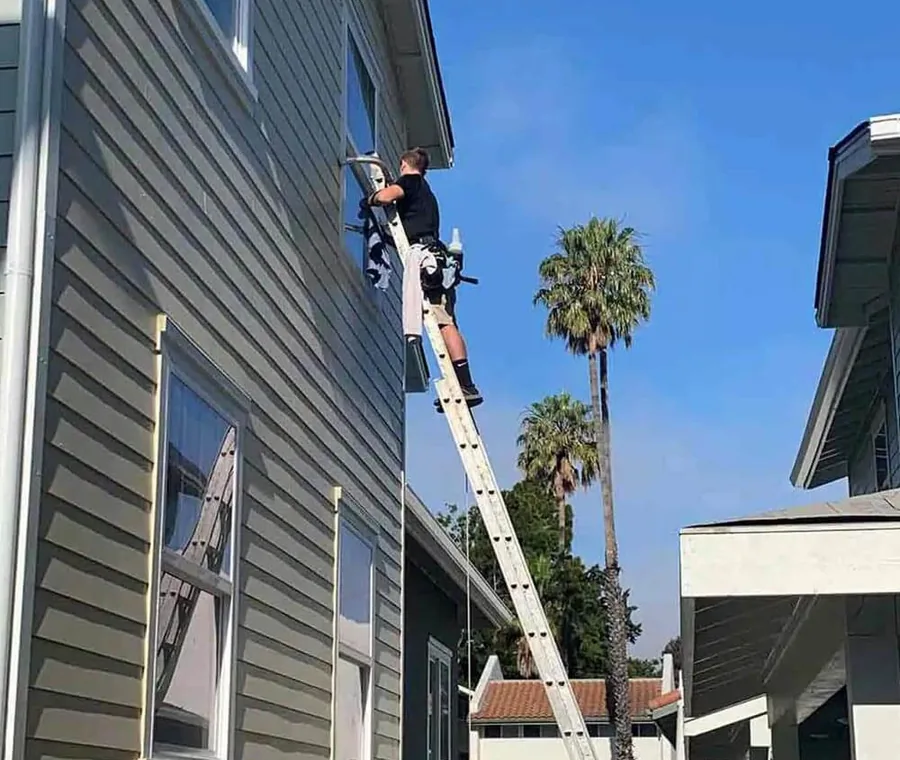
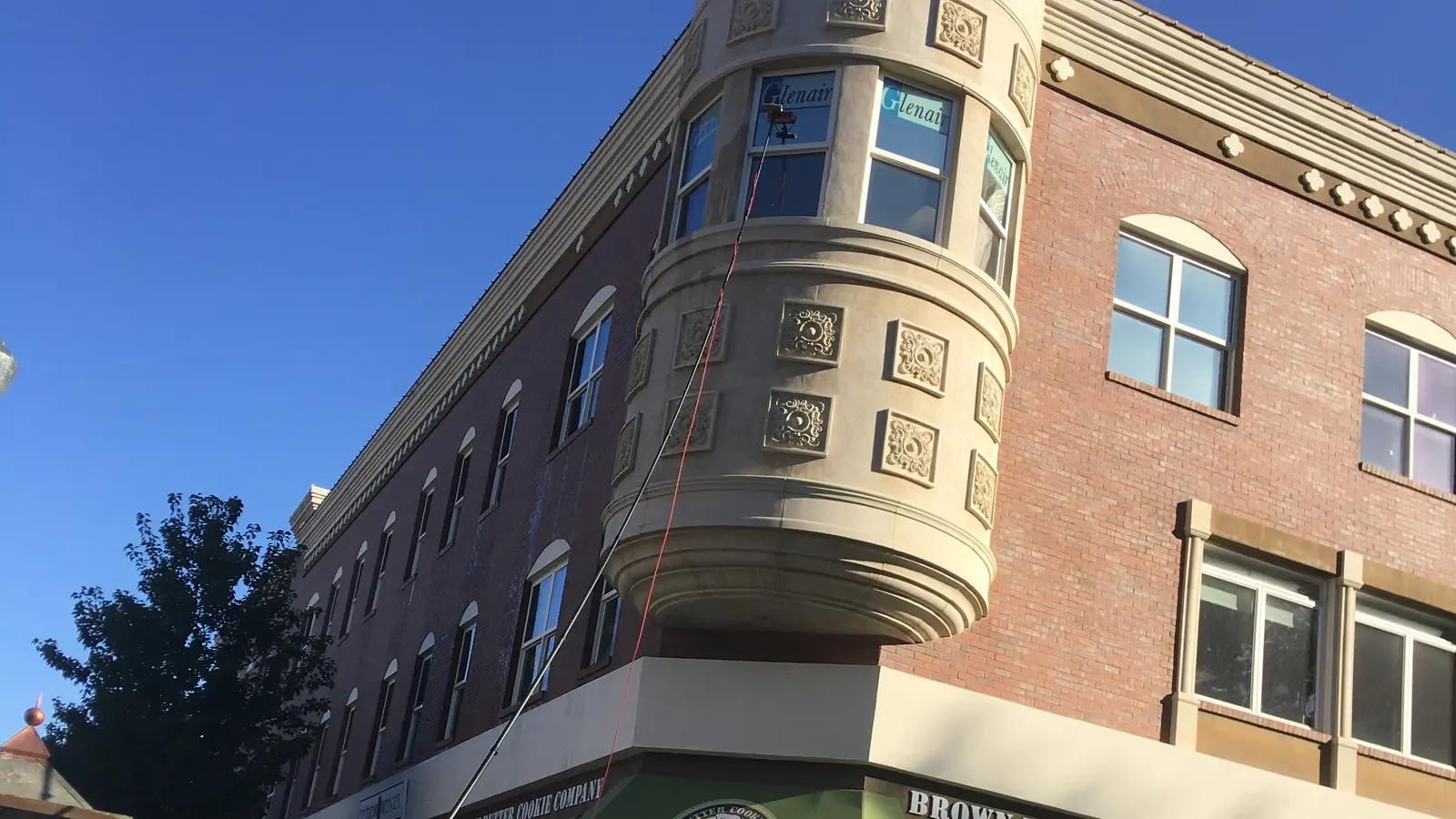
Soft washing cleans with a cleaning solution applied at roughly garden hose pressure and left to dwell. Pressure washing cleans with force. Soft wash anything soft, porous, painted or laid in overlapping courses: composition and tile roofs, stucco, painted siding, vinyl and wood shingle. Pressure wash hard flatwork, and use a surface cleaner rather than a wand: concrete driveways, patios, walkways, pavers, brick and block walls. Wood decking sits between the two and wants low pressure, because softwood furs under a narrow tip. Most Central Coast homes need both methods, often on the same visit.
Soft washing does the work with the solution, not the water
Soft washing puts a cleaning solution on the surface through a low pressure applicator. At the wall it is roughly what a garden hose puts out, soft enough that you could hold your hand in front of it. The solution sits there for a few minutes and breaks the bond between the surface and whatever is growing on it or stuck to it. Then the whole wall gets rinsed at that same low pressure. The water is there to carry the solution up and wash it back down. It is not doing the cleaning.
Dwell time is the part people skip and the part that matters. The dark staining on a shaded north wall is alive, and it has roots down in the pores of the stucco or the grain of the wood. Force knocks the top off it. The wall goes lighter for a season and then comes back darker in the same pattern, because nothing killed it. A solution given a few minutes reaches down where a jet never will. That is the trade off: soft washing is slower on the clock and the result lasts far longer.
The other thing low pressure buys you is that nothing is being driven anywhere. Water at pressure goes where it finds a gap, and every house is full of gaps: window seals, siding laps, shingle courses, vents, light fittings, the top edge of a door. A soft wash rinse works from the top down, so nothing travels upward under a lap and nothing gets forced behind a wall it cannot drain out of. That is not a small detail. It is most of the reason the method exists.
Pressure washing cleans with force, and on hard flatwork it wins
Pressure washing is the opposite approach. A pump raises the water pressure, a tip narrows it into a fan, and the water knocks dirt loose mechanically. No chemistry is strictly required for ordinary dirt, though treating a surface first almost always makes the job faster and the result last longer. It is quick, it is direct, and on a surface that can take it there is nothing better. The mistake is not using pressure. The mistake is using it on something that cannot take it.
Concrete is where pressure earns its place, and it is not a close call. A slab is porous, and the dirt is not sitting politely on top of it. Tire black, road film, harvest dust and the gray of ordinary weathering are down inside the texture. A solution kills the growth in there but it cannot flush the rest out, because rinsing at garden hose pressure has no volume behind it. Water at pressure does. That is why a properly washed driveway comes back to a color the owner has usually forgotten it had.
Same goes for pavers, brick, block walls, pool decks, steps and any masonry that is one solid mass with nothing behind it to protect. There is no lap to get under, no paper layer, no coating to lift, no soft growth ring to carve out. Anybody who tells you high pressure is never the right answer is selling you one method and hoping the rest of your property does not come up in the conversation.
Surface by surface, which method goes where
Here is the whole list laid out, and it is not a matter of taste or company preference. Each line has a reason underneath it, and the reasons come down to the same three questions every time. Can the surface be worn away? Can a coating or a layer be lifted off it? Can water be driven in behind it and left with no way back out? Answer yes to any of the three and the solution should do the work.
Two entries below catch people out. Vinyl looks tough, and it is, but it hangs in overlapping courses with a drainage plane behind it, so a jet aimed up under a course puts water into the wall cavity. Wood decking is the genuine middle case. It wants low pressure rather than no pressure: a wood safe cleaner plus a wide fan run along the grain gets the boards clean, while the same fan turned narrow carves the soft growth rings out and leaves ridges you cannot sand off a horizontal board.
- Composition shingle roof: soft wash only. Pressure strips the granules off.
- Clay or concrete tile roof: soft wash. A wand cracks tile and drives water under the laps.
- Stucco: soft wash. The sand finish comes off under pressure and does not go back on.
- Painted wood or fiber cement siding: soft wash. Pressure lifts paint edges and takes chalking coatings off in patches.
- Vinyl siding: soft wash. It hangs in courses, and a jet aimed upward puts water into the wall.
- Wood shingle and shake: soft wash. Cedar is soft and fuzzes under a narrow tip.
- Concrete driveways, patios, walkways and pool decks: pressure, with a surface cleaner rather than a wand.
- Pavers and brick: pressure, dialed back, then top the joint sand back up.
- Block and masonry walls: pressure, after checking for loose mortar.
- Wood decking and fencing: low pressure with a wood safe cleaner. Softwood furs in seconds and takes a refinish to undo.
- Composite decking and trim: low pressure. The surface is plastic and it scars.
What high pressure actually does to shingle and to stucco
The roof is the most expensive mistake available. The colored granules on a composition shingle are not decoration. They are the only UV shield the asphalt underneath has. A pressure washer takes them off, and you can age a roof by several years in one afternoon. The evidence washes into the gutter and sits there as black grit, which is worth checking if somebody has recently cleaned your roof. Most shingle manufacturers exclude pressure washing damage from the warranty outright, which tells you what they make of it.
Stucco fails differently and just as permanently. A stucco wall is a thin sand finish over a brown coat over paper and lath. A narrow jet cuts the sand off wherever it lingers, so the wall dries with light and dark bands that will not blend back. At the same time it forces water past the hairline cracks every stucco wall already has, through to the paper, where there is no route out. That matters more here than most places, because stucco is on nearly every house from Paso Robles down to Arroyo Grande.
What both have in common is that the damage does not show on the day. The roof looks cleaner. The wall looks cleaner. Everybody is happy and the check gets written. The granule loss turns up as a roof that fails years early, and the water behind the stucco turns up the following winter as staining and blistered paint. That gap between doing it and seeing it is exactly why the method keeps getting used.
Why a surface cleaner beats a wand on flatwork
Once you are on concrete and pressure is the right call, the tool matters as much as the pressure setting. A surface cleaner is a shrouded disc with spinning jets underneath. It sits flat on the slab and holds one height, one speed and one width across the whole run. Everything the water lifts stays inside the shroud instead of firing across your planting beds. It also covers ground several times faster than a wand, which is the part people notice on an invoice.
A wand cleans in an arc. The center of the fan carries more energy than the outside edge, so unless every single pass overlaps the last one perfectly you get a zebra pattern: light bands where the arcs crossed, darker ones where they did not. It looks fine while the slab is wet. It shows up an hour later once the concrete dries, and it does not wash off. The only real fix is redoing the whole slab with a surface cleaner in straight overlapping passes at a steady walking speed.
The wand still has a job. A shroud cannot sit flat against a garage door, a wall, a step nose, an expansion joint or the curved apron at the street, so those last couple of inches get finished by hand with a wide tip kept moving and kept back from the surface. A clean slab with a dark border around it is the clearest sign a driveway was rushed.
Most properties need both, usually on the same day
A typical home around here needs both methods, and there is no conflict in that. The roof gets soft washed. The stucco, the trim and the eaves get soft washed. The driveway, the front walk, the back patio and the pool deck get pressure and a surface cleaner. The fence and the deck sit in the middle at low pressure with a wood safe cleaner. That is one visit, one setup and two completely different approaches, picked surface by surface.
The warning sign is a contractor who brings one method to the whole property. If everything gets pressure, something on the house gets damaged. If everything gets a soft wash, the flatwork comes out half done and goes back to gray within months. Ask which method is going on which surface before anybody unrolls a hose. If the answer is the same for your roof and your driveway, keep calling around.
Crystal Clean A1 is owner operated. Corey Byler followed his father into this trade and he is the one on your property, because nothing here is ever subcontracted. Business license #17881, insured to $1,000,000, certificate on request. Monday to Saturday, 7:00 AM to 6:00 PM across San Luis Obispo County. Every job ends with a walk around before anything is packed up, and anything you are not happy with gets put right there and then. Phone (805) 952-5718.
Questions people ask about this
Is soft washing better than pressure washing?
Can a driveway be soft washed instead of pressure washed?
How can I tell whether a contractor is actually soft washing?
What does pressure washing do to stucco?
Does wood decking need soft washing or pressure washing?
Related on this site