Solar Panel Cleaning · Santa Maria
Solar Panel Cleaning in Santa Maria
Panel level monitoring finds a bad module by comparing it against the good ones beside it. Santa Maria delivers field soil to every module in the same amounts on the same afternoons, so a whole array can slide down together with nothing left for the instrument to compare it against.
Serving Santa Maria · License #17881 · Insured to $1,000,000
Get a quote for solar panel cleaning in Santa Maria
Monitoring compares modules, and this valley loads them all the same
Panel level and string level monitoring is built on comparison. It watches modules against each other and raises a flag when one of them falls behind the rest, which is how a failed diode, a cracked cell or a dropping on one panel gets caught. Santa Maria produces the one kind of loss that architecture cannot see. Field soil arrives on the valley wind and lands across every module of an array in the same amounts on the same afternoons, so the whole system slides together and nothing reads out of line. No outlier means no alarm, and the array quietly produces several percent under its own past behind a screen that looks healthy.
The reading that does find it is the array against its own history. September this year against September last year, taken off clear days, is a comparison most monitoring apps will draw in a few taps, and it is the only instrument on the property capable of seeing an even loss. The trap is picking the wrong pair of days. Production here swings much harder with the season and with the marine layer than it ever does with dirt, so April against August tells you nothing and a bright week against a foggy one tells you less. Same month, clear days, twelve months apart is the only pair that isolates the soil.
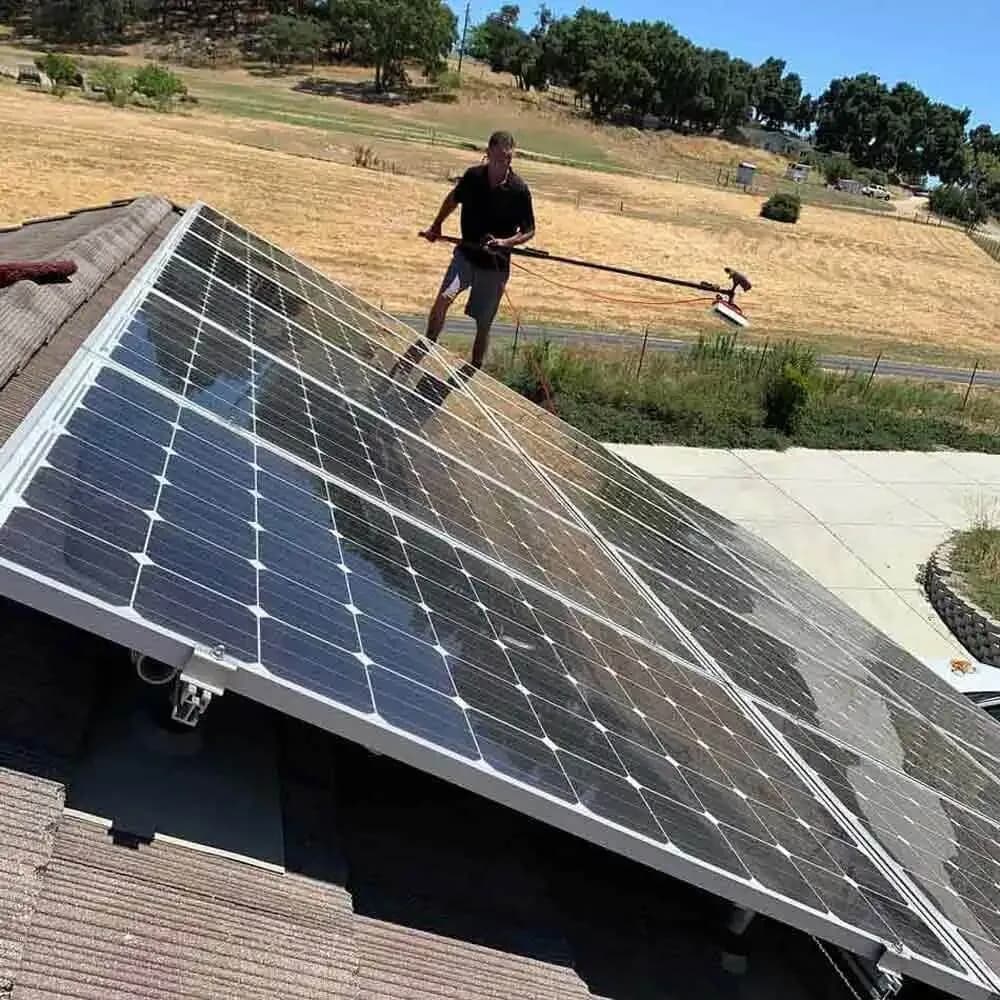
What makes the loading so even is the delivery. The valley opens west to the ocean, the sea breeze runs through it most afternoons at close to the same strength, and the soil it carries is fine enough to stay up over a whole roof rather than dropping out on the windward row. Nothing about a Santa Maria array breaks the pattern afterward either. The panels sit shallow on low pitch subdivision roofs, there is no canopy over most of them to drop litter on one corner, and no harbor anywhere near to put birds on a top rail. Even delivery, even accumulation, no outlier.
What changes in Santa Maria
The rim at the bottom rail is the one uneven thing up there
Everything else about Santa Maria soiling lands flat, but the aluminum frame stands proud of the glass and dams whatever runs down the face, so soil collects in a line along the bottom edge. What is particular here is the rebuild rate. That line reforms after any night heavy enough to leave dew on the modules, so it is a standing feature of the array rather than a once a year cleanup.
A ground mount at a field edge breaks the pattern
Out by the fields the grit is coarse, thrown up by disc work and by traffic on the dirt roads rather than carried high on the wind, and the bottom row of a ground mount takes splash from below as well. That array does load unevenly, which makes it the rare Santa Maria system where the monitoring actually has something to flag.
The commercial arrays lose the most and are watched the least
Packing, cooling and shop buildings along Betteravia Road and out toward the airport carry large arrays on low slope roofs. Nobody walks up to look at them, and nobody is putting this September beside last September on a system that size either. A few percent of even soiling on an array like that is a real figure on a bill, and it can run for years without anyone noticing.
One reading proves nothing in this town
A single output figure says nothing about a Santa Maria array, because there is no clean module on the roof to hold the dirty ones against. What is worth doing is writing down the output on a clear day right after a clean, and again on a clear day before the next one. Two numbers twelve months apart is the whole diagnostic here, and nobody sells it.
How often, here
Two visits a year is the sensible starting point for a Santa Maria array and three is common, but the honest version is that the number here is an output rather than an input. Start at two, keep the clear day readings, and let the gap between this year and last year decide whether the array has earned a third. Ground mounts at a field edge and systems out along the canyon roads generally do. Commercial arrays on the Betteravia side usually end up quarterly, not because the soil out there is any different but because nobody on those roofs will ever notice if the schedule slips. Cambria books its solar work around what the trees are doing. Santa Maria books it around a number.
Real reviews, real Central Coast addresses
The light literally shines brighter
Every word below is lifted straight from Corey's Google profile. Nothing written by us, nothing tidied up.
Questions from this area
Why does my monitoring show no problem when my Santa Maria solar panels are dirty?
How often should solar panels be cleaned in Santa Maria?
Why is there a line of dried soil along the bottom edge of my Santa Maria solar panels?
Do you clean ground mount and commercial solar arrays in Santa Maria?
No obligation, no pressure, no call center
We Guarantee 100% Satisfaction
Every job finishes the same way: a walk around with you before we pack up, so anything you are not happy with gets put right there and then. Corey Byler is the one doing that walk around. Business License #17881, insured to $1,000,000, and no part of the job handed to somebody else.
Other work we do in Santa Maria
Need solar panel cleaning in Santa Maria?
Send the address and you get a real number. Solar Panel Cleaning across Santa Maria and the rest of Santa Barbara County.
Monday to Saturday, 7:00 AM to 6:00 PM · Owner operated · Nothing subcontracted