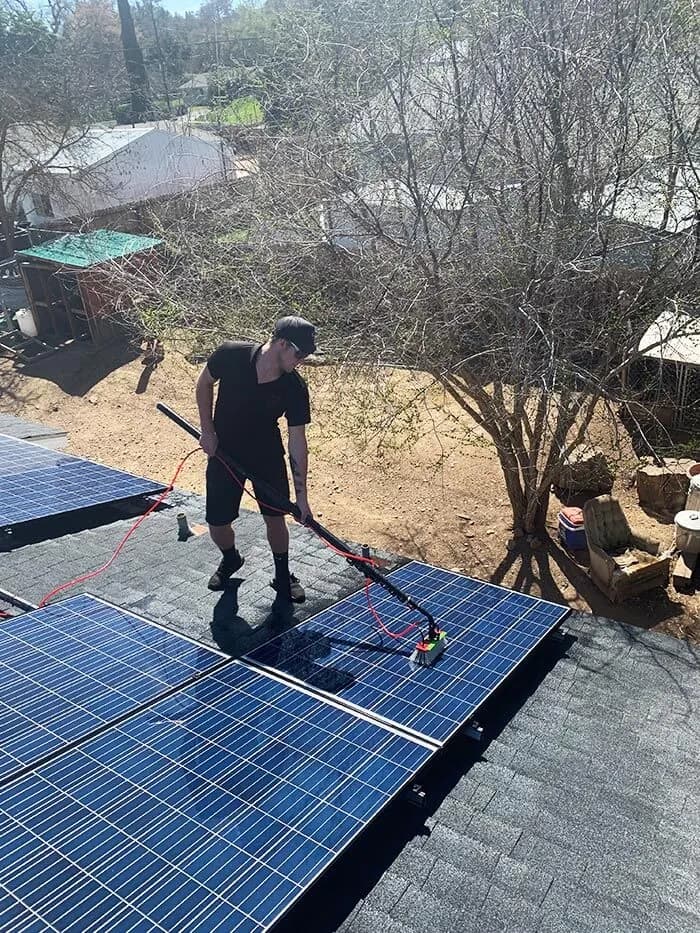
Roof Cleaning · Santa Maria
Roof Cleaning in Santa Maria
A Santa Maria roof is too dry and too bright to grow anything on its own, and plenty of them grow moss anyway. The valley supplies the bed of field soil and the two story house six feet away supplies the shade.
Serving Santa Maria · License #17881 · Insured to $1,000,000
Get a quote for roof cleaning in Santa Maria
The valley delivers the soil, the neighbor delivers the shade
The bed comes first, because everything else on a Santa Maria roof sits in it. Fine field soil lands on a wide, low pitched plane every afternoon the valley wind runs. A shallow pitch moves water too slowly to carry any of it off, so whatever settles into the pans of a tile roof or the gaps of a shingle roof stays where it landed and builds. That bed is not dirt sitting on a roof, it is a rooting medium: mineral particles fine enough to hold water between them, lying in a shallow tray and restocked all year. Shade is the only other thing it needs, and that gets supplied separately, by the house next door.
The shade in Santa Maria was built rather than grown. These subdivisions put two story houses about six feet apart, so each one throws a permanent shadow across the lower courses of the roof next door, and where that shadow lands is decided by the street grid instead of by the compass. Hold overnight dew in a bed of mineral soil inside a strip that stays cold until noon and moss and gray lichen have everything they need. Almost always it is one slope, often four or five courses of one slope, and the rest of the roof is genuinely fine.
Pressure is the wrong tool on any roof, and on the concrete tile common here it causes damage that compounds instead of fading. That tile takes its color from a slurry applied to the surface rather than from the body underneath, and a wand lifts the coat off in stripes. What is left is more absorbent than what was there, so it holds the next season of valley soil better than the coating it replaced. In a town that delivers dust daily, stripping a roof hands the growth a deeper bed to sit in. Composition shingle fails the same way once the granules are gone.
What changes in Santa Maria
The growing side faces your neighbor, not north
On most properties the shaded slope is the north one. In a Santa Maria subdivision it is whichever slope the house next door shades, so it can be the east or the west side depending on how the street was laid out and where the two story pads landed. That shadow does not move, which is why the growth sits on the same four or five courses year after year.
The debris is spread through the pans, not sitting in the valleys
An oak litter roof inland drops its load into two or three valleys and you clear those. A Santa Maria roof carries a thin, even bed of field soil through the pans of every tile course and along the back of the ridge caps, so clearing it means a full pass across the whole roof rather than picking out the obvious spots. It takes longer and it looks like less work.
What lands here is windborne, so it never sits still
No oak tassel and no pine needle. A Santa Maria roof takes dry field chaff, stalk litter, torn pieces of mulch film off the row crops and the soil itself, and all of it keeps traveling on the wind until something stops it. The stops are the ridge line, the flashings and anywhere a course steps, and that is where the deep piles turn up.
Old Town roofs behave like a normal town's roofs
Nearer Old Town and Broadway the stock is older and lower with mature street trees over it, so those roofs get ordinary leaf litter and ordinary shade, and the neighbor geometry stops deciding anything. They are also composition shingle that has taken decades of valley sun and gone brittle, which is a reason to work them from ladders and the edges rather than to walk them.
How often, here
Two numbers on the same Santa Maria roof, and one of them drives the other. Clearing field soil and wind litter out of the tile pans is yearly work, because a plane this shallow sheds none of it on its own. Treating the shaded courses for moss and lichen holds three to four years, which is a long interval for roof growth and only holds because the bed keeps getting taken away underneath it. Let the pans run four or five years and the growth clock speeds up by itself, since the moss is not living on the tile, it is living in what was left on it. Arroyo Grande carries a similar mineral bed off its own farmed valley and comes due sooner, at about three years, because a roof there wets and dries every day of the year while the damp here is confined to the courses the neighboring house shades. Nobody sells it this way, but on a Santa Maria roof the cheap annual job is what protects the expensive one.
Real reviews, real Central Coast addresses
The light literally shines brighter
Every word below is lifted straight from Corey's Google profile. Nothing written by us, nothing tidied up.
Questions from this area
Do roofs in Santa Maria get moss and lichen if the town is dry and sunny?
Can you pressure wash a tile roof in Santa Maria?
What is the dark buildup in the pans of my Santa Maria tile roof?
How often does a roof need cleaning in Santa Maria?
No obligation, no pressure, no call center
We Guarantee 100% Satisfaction
Every job finishes the same way: a walk around with you before we pack up, so anything you are not happy with gets put right there and then. Corey Byler is the one doing that walk around. Business License #17881, insured to $1,000,000, and no part of the job handed to somebody else.
Other work we do in Santa Maria
Need roof cleaning in Santa Maria?
Send the address and you get a real number. Roof Cleaning across Santa Maria and the rest of Santa Barbara County.
Monday to Saturday, 7:00 AM to 6:00 PM · Owner operated · Nothing subcontracted